
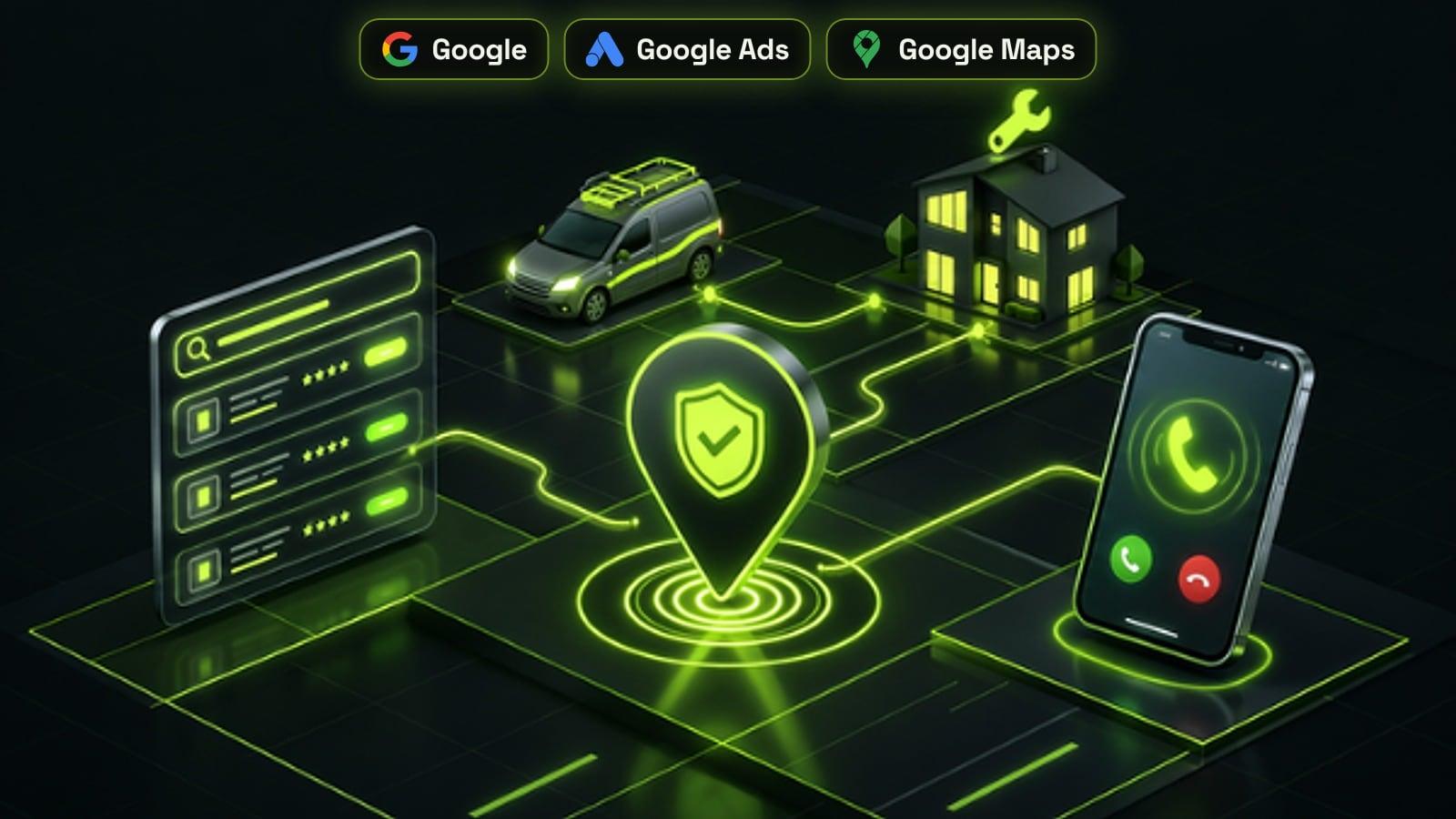
Google Local Services Ads charge you for each valid lead, such as a phone call or message, while Google Search ads charge for each click, whether or not the visitor ever contacts you. For most home and local service businesses in eligible categories, Local Services Ads are the safer starting point because you pay only when a customer reaches out, and the Google Verified badge builds trust. Search ads give far more control over keywords, landing pages and tracking, and work in any industry. In 2026 Google began moving Local Services Ads into Google Ads as Performance Max campaigns with pay-per-lead goals, starting with US home service categories in August, which changes how they are managed but not how you are billed. Many businesses get the best results by running both and comparing cost per booked job.
How Local Services Ads work
Local Services Ads appear on Google Search and Google Maps when someone searches for a service in an eligible category, such as plumbing, HVAC, electrical work, cleaning or pest control. There are no keywords to choose. Google matches your ad to searches using the services and areas in your profile, and shows your rating and reviews alongside it.
You pay per valid lead rather than per click. Google counts an answered call, a missed call during business hours where the caller waits more than 20 seconds, a voicemail, a message and, in the US and Canada, a booking request. Repeat contact from the same number or email within 15 days is not charged again, and Google says message leads are usually priced lower than phone leads.
How Google Search ads work
Google Search ads show for the keywords you bid on, and you pay each time someone clicks through to your website or taps to call. You choose the keywords, write the ads, pick the landing page and decide how much to bid, which gives you much more control and works for any business, not just the trades Local Services Ads cover.
That control comes with more work and more risk. Clicks cost money whether or not the visitor contacts you, so results depend on keyword choice, negative keywords, the landing page and conversion tracking. WordStream by LocaliQ's 2026 benchmarks put the average Google Search cost per lead at $66.69 across industries, and our comparison of Google Ads and Meta Ads for lead generation shows how that varies by sector.
Local Services Ads vs Google Search ads at a glance
The two formats suit different situations, and they are not mutually exclusive. These are the differences that matter most when you are choosing where to put your budget.
- Billing: Local Services Ads charge per valid lead; Search ads charge per click
- Eligibility: Local Services Ads are limited to set service categories and countries; Search ads work for any business
- Control: Local Services Ads have no keywords or landing pages; Search ads let you pick keywords, copy, landing pages and bids
- Trust: Local Services Ads carry the Google Verified badge once you pass screening; Search ads rely on your ad copy, extensions and reviews
- Tracking: Local Services Ads report calls and messages; Search ads can report form fills, calls and, with offline conversions, closed revenue
- Effort: Local Services Ads need a complete profile, reviews and fast responses; Search ads need ongoing keyword, bid and landing page management
The Google Verified badge
In October 2025 Google replaced its older Local Services badges, including Google Guaranteed, Google Screened and License Verified by Google, with a single Google Verified badge. Businesses that had already completed screening earned the new badge automatically, and new advertisers get it once they pass the Local Services screening and verification process for their category.
Google also ended the Money Back Guarantee that came with the old Google Guaranteed badge, accepting claims only for services booked before 7 December 2025. If your ads or website still promise customers the Google Guarantee, update them, because that protection no longer exists.
What changes with the move to Performance Max
Google is moving Local Services Ads into Google Ads as Performance Max campaigns with pay-per-lead goals. The first phase started in August 2026 for selected US home and storefront service categories, including plumbing, HVAC, electrical, appliance repair, house cleaning, lawn care, roofing, pest control and moving. Service-area businesses without a storefront follow in late 2026, and accounts outside the US and remaining categories in 2027.
- Billing stays per valid lead, and ads still show only on Google Search and Google Maps in the same positions
- Management moves into Google Ads, and the old Local Services dashboard stops working after migration
- Lead history carries over, but historical performance reports do not, so download them before your account moves
- Manual bidding is removed and weekly budgets become average daily budgets
- Verification status and the Google Verified badge carry over automatically
- Manual lead disputes are no longer supported; Google credits low-quality leads automatically instead
Lead quality, disputes and credits
Paying per lead does not mean every lead is a customer. Some calls are for services you do not offer, areas you do not cover or simple price checks. Google now reassesses charged leads with machine learning and credits those it later judges to be low quality, usually within 30 days. Accounts not yet migrated can still dispute some leads in the US and Canada, but after migration automatic credits are the only route, and Google does not credit leads for job types or areas you do not serve.
That makes your profile settings the main defence. Keep the job types and service areas tight, answer every call quickly, and log each lead's outcome in your CRM. Our guides to speed to lead and AI voice agents for missed calls cover how to make sure no paid lead goes unanswered.
Which should you choose?
Start with Local Services Ads if your trade is eligible, you can answer the phone reliably and your budget is modest, because you only pay when someone gets in touch. Your rating appears on the ad, so pair them with automated review requests and a complete Google Business Profile.
Add Google Search ads when you want to target specific high-value jobs, need landing pages that sell a particular offer, or work in a category Local Services Ads do not cover. Track both channels to booked jobs and revenue, not just leads, using offline conversion tracking and lead source tracking in your CRM. If you want help setting up and managing both, our media buying service runs Google campaigns alongside the CRM follow-up that turns leads into jobs.
Frequently asked questions
What is the difference between Local Services Ads and Google Ads?
Local Services Ads charge per valid lead, such as a call or message, and have no keywords or landing pages. Google Search ads charge per click and let you choose keywords, ad copy, landing pages and bids. Local Services Ads are limited to eligible service categories, while Search ads work for any business.
Are Google Local Services Ads worth it?
For eligible home and local service businesses they usually are, because you pay only when a customer contacts you and the Google Verified badge builds trust. They work best when you answer calls quickly, keep your service areas and job types accurate, and collect a steady flow of reviews.
What counts as a lead in Local Services Ads?
Google charges for an answered call, a missed call during business hours where the caller waits more than 20 seconds, a voicemail, a message and, in the US and Canada, a booking request. Repeat contact from the same number or email within 15 days is not charged again.
What happened to the Google Guaranteed badge?
In October 2025 Google replaced Google Guaranteed, Google Screened and License Verified by Google with a single Google Verified badge. The Money Back Guarantee was discontinued and only covered services booked before 7 December 2025.
Are Local Services Ads moving to Performance Max?
Yes. Google began moving Local Services Ads into Google Ads as Performance Max campaigns with pay-per-lead goals in August 2026, starting with selected US home service categories. Other US businesses follow in late 2026 and other countries in 2027. Billing stays per lead, but management moves into Google Ads.
Can I get refunds for bad Local Services Ads leads?
Google reassesses charged leads and credits low-quality ones automatically, usually within 30 days. Once an account has moved to Performance Max, manual disputes are no longer supported. Leads for job types or areas you do not serve are not credited, so keep those settings accurate.
Sources
- How leads work, Google Local Services Help
- About Automated Local Services Ads lead credits, Google Local Services Help
- Local Services Ads transition to Performance Max campaigns with pay-per-lead goals, Google Ads Help
- Google Verified makes it easier to find trusted local businesses advertising on Google, Google
- About Google Verified badge, Google Local Services Help
- 2026 Google Ads Benchmarks, WordStream by LocaliQ